Inconsistent Adoption
The AI-assisted platform was available, but many designers were reluctant to incorporate it into their established workflows.
Flagship Case Study · Performance Consulting
A six-week professional learning and organizational change strategy designed to help experienced creative professionals adopt AI-assisted tools without sacrificing artistic integrity, scientific accuracy, professional identity, or human judgment.

This consulting-style project was developed for Meca Oceanic Graphics, a fictional organization facing resistance after introducing an AI-assisted design platform.
The Challenge
The organization had already acquired the technology. The larger challenge was helping experienced designers see AI as a tool that could support their expertise rather than replace it.
The AI-assisted platform was available, but many designers were reluctant to incorporate it into their established workflows.
Designers were concerned that AI could diminish the value of their artistic expertise, creative autonomy, and professional relevance.
Participants questioned whether AI-generated illustrations could meet the organization’s standards for scientific accuracy, communication, and artistic quality.
Employees had not received enough structured practice, feedback, collaboration, or workplace support to build confidence with the new system.
Discovery and Analysis
Rather than assuming that additional software demonstrations would solve the problem, we examined the performance gap, stakeholder concerns, workplace context, and organizational expectations.
The analysis indicated that participants already possessed deep artistic and scientific expertise. The missing elements were confidence, structured practice, trust, and a clear model for determining where human judgment adds value.
The solution would not position AI as a replacement for professional expertise. It would teach participants how to use AI as a collaborative tool while preserving human oversight, creative control, scientific judgment, and artistic standards.
Evidence-Based Foundation
Three complementary frameworks shaped the instructional strategy, organizational support, and evaluation plan.
Kolb’s cycle informed hands-on practice, reflection, evaluation, experimentation, and authentic workplace application.
Kotter’s principles supported trust building, communication, participation, shared ownership, and visible internal advocacy.
The evaluation plan measured reaction, learning, workplace behavior, and organizational results rather than satisfaction alone.
Learning Objectives
The objectives addressed technical competence and the mindset required for successful adoption.
Explain the capabilities, limitations, and ethical considerations associated with AI-assisted design.
Demonstrate proficiency using key features of the AI-enhanced design platform.
Evaluate AI-generated work for scientific accuracy, artistic quality, and educational effectiveness.
Improve AI-generated products through professional artistic judgment and domain-specific expertise.
Integrate AI-assisted tools into existing workflows while maintaining human oversight and creative control.
Demonstrate increased confidence and willingness to use AI-supported tools in professional practice.
The Solution
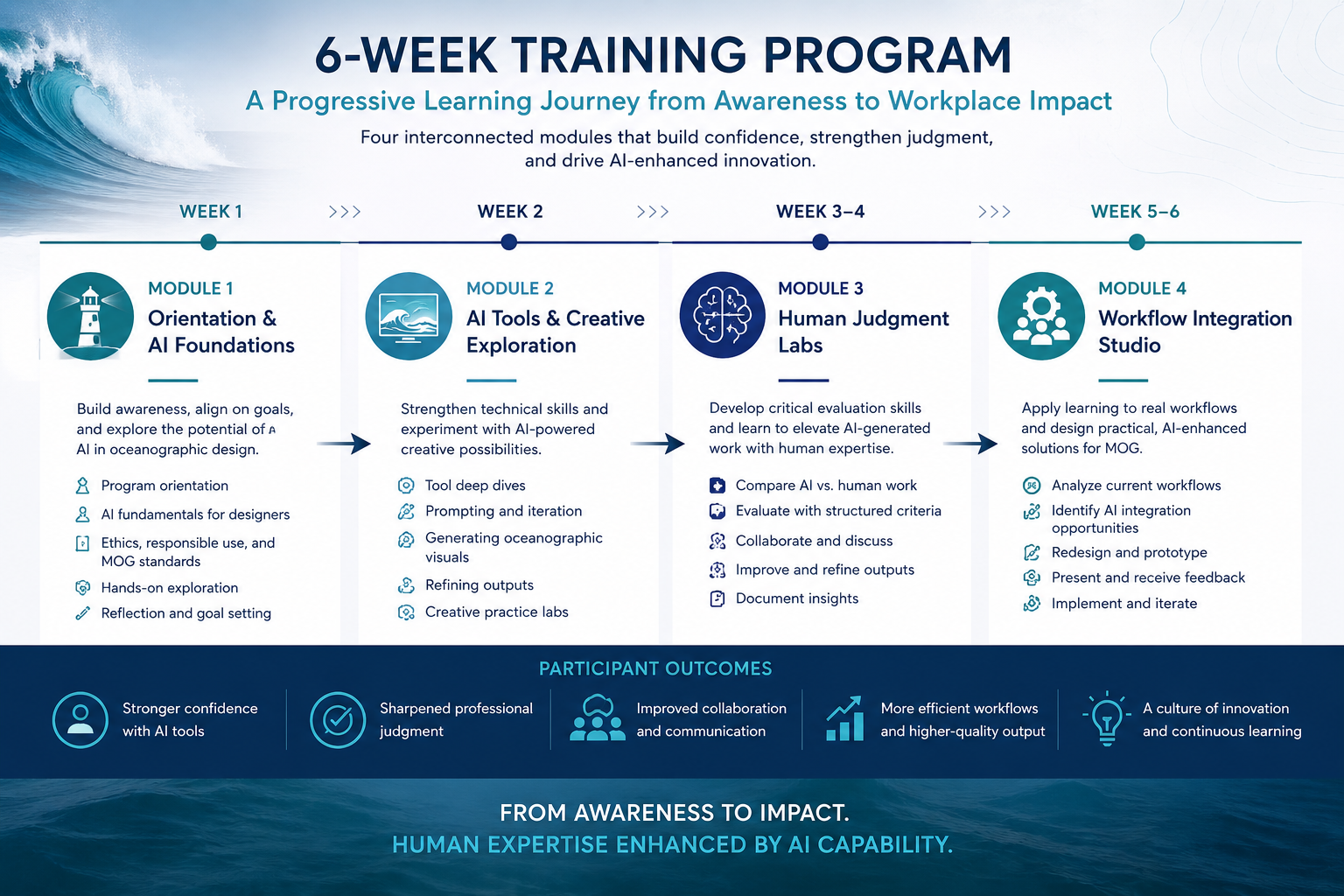
Four interconnected modules moved participants from awareness and technical confidence to professional judgment and authentic workflow integration.
Module 1
Build awareness, address misconceptions, clarify expectations, and establish psychological safety.
Module 2
Develop technical familiarity through demonstrations, guided practice, iteration, and creative experimentation.
Module 3
Reinforce the continued value of professional expertise through structured evaluation and revision.
Module 4
Transfer learning to real work by redesigning workflows and developing implementation plans.
Signature Learning Experience
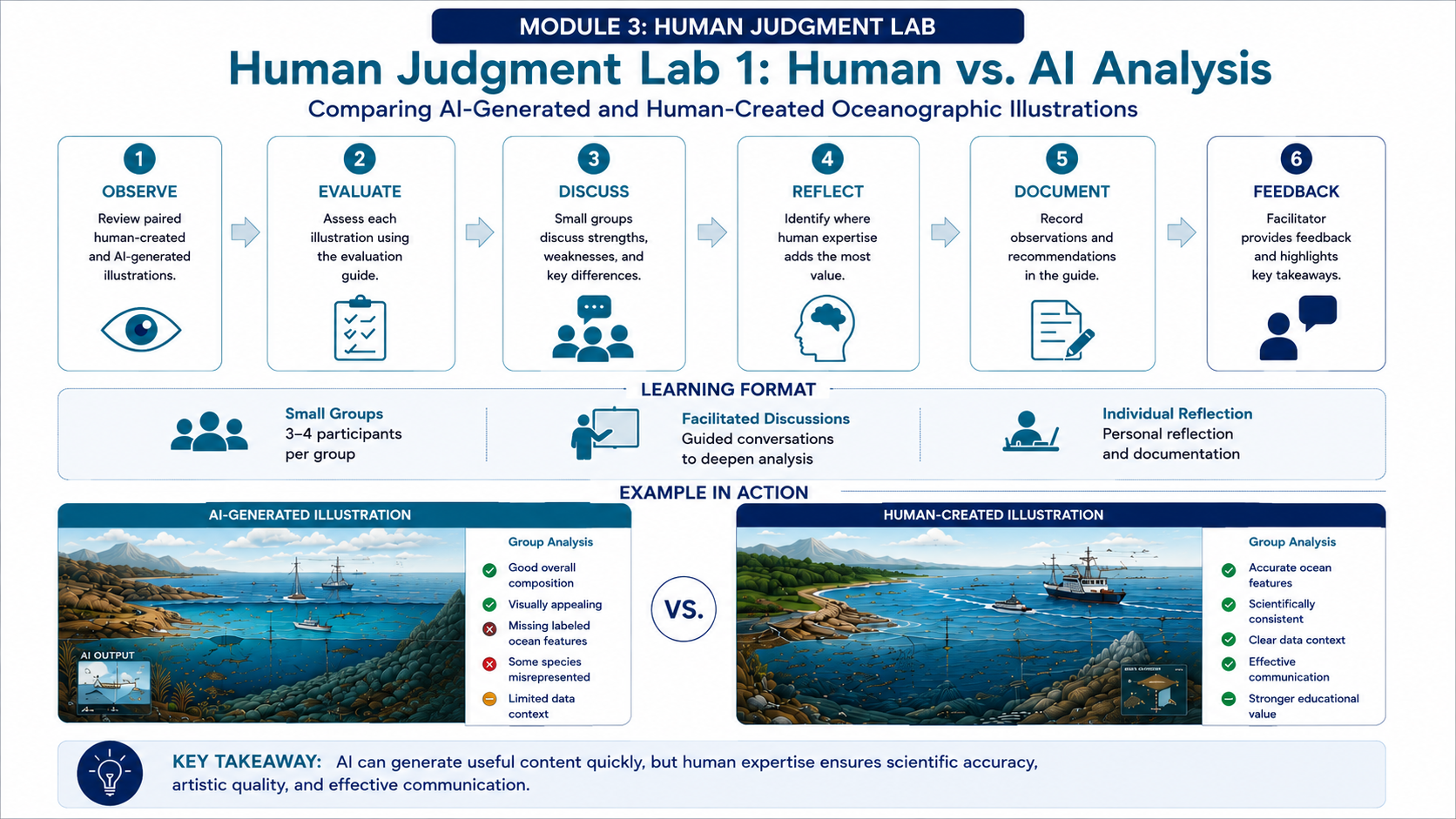
The Human Judgment Labs became the signature component of the solution because they directly addressed the emotional and professional concerns surrounding AI adoption.
Participants compared AI-generated and human-created oceanographic illustrations, evaluated each using structured criteria, discussed strengths and weaknesses, and identified where human expertise created the greatest value.
Rather than asking designers to accept AI uncritically, the labs invited them to challenge, critique, refine, and improve its output.
AI can generate useful content quickly, but human expertise remains essential for scientific accuracy, artistic quality, contextual judgment, and effective communication.
Workplace Transfer
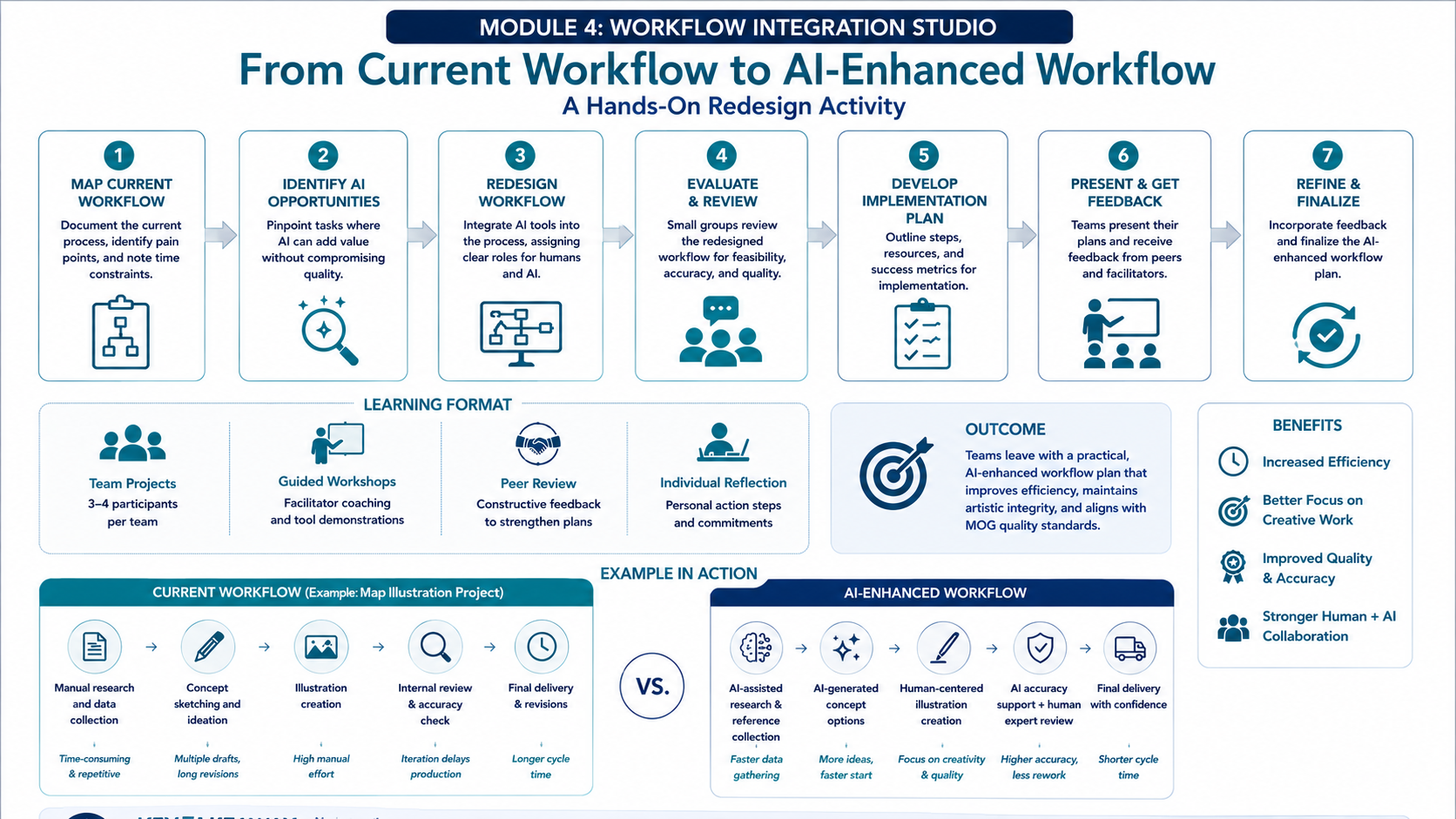
The final module moved beyond practice exercises and required participants to redesign a real professional workflow.
Teams mapped current processes, identified pain points, evaluated appropriate AI opportunities, assigned clear responsibilities to humans and AI, established success metrics, and presented their plans for feedback.
This structure supported transfer by connecting instruction to actual work rather than ending the program with isolated tool practice.
Assessment Strategy
Assessment supported learning, feedback, reflection, and demonstration of workplace-ready performance.
Reflection journals, guided practice, peer critique, facilitator observation, group discussion, and Human Judgment Lab activities provided continuous feedback.
Participants produced an original AI-assisted illustration, evaluated its limitations, improved it through professional expertise, and documented the role of human judgment.
Evaluation Plan
Kirkpatrick’s four levels connected the learning experience to workplace behavior and organizational results.
Surveys and reflection responses measure relevance, satisfaction, confidence, and perceived value.
Human Judgment Labs, portfolio evidence, guided practice, and facilitator observation demonstrate knowledge and skill.
Workflow reviews and supervisor observations assess whether participants transfer AI-supported practices to the workplace.
Adoption rates, efficiency measures, completion metrics, and quality reviews evaluate organizational impact.
AI Collaboration
Generative AI supported research organization, idea generation, visual exploration, refinement, and presentation development. However, all instructional decisions remained grounded in the case context, learning objectives, evidence, professional judgment, and collaborative review.
AI was used to expand options and accelerate development, not to replace analysis or professional judgment. Houman Rassa and Tessin Ziegler retained responsibility for the strategy, instructional content, theoretical alignment, evaluation plan, visual review, and final approval.
Executive Presentation
The final presentation translated the full treatment plan into a concise executive narrative focused on organizational need, learning strategy, implementation, and impact.
Project Deliverables
The treatment plan contains the complete needs assessment, learning objectives, theoretical alignment, module design, assessment strategy, accessibility plan, and evaluation framework.
Review the full consulting document, including the organizational needs assessment, six learning objectives, four-module program, assessment plan, accessibility considerations, and Kirkpatrick evaluation strategy.
Watch the stakeholder-facing video presentation summarizing the performance gap, learning solution, Human Judgment Labs, implementation strategy, and anticipated organizational outcomes.
Professional Reflection
This project expanded my understanding of the instructional designer’s role beyond course development. It required us to analyze an organizational need, distinguish training from broader performance and change issues, build a complete implementation strategy, and communicate the solution in a consulting-style format.
It was also the first graduate project in which I could clearly imagine myself doing this kind of work professionally. I enjoyed translating ambiguity into strategy, connecting learning to organizational performance, collaborating on the design, and thinking beyond instruction toward adoption, culture, and sustainable change.
Key professional insight:
Instructional designers are not simply course developers. They are strategic partners who help organizations identify real performance needs and develop thoughtful, human-centered solutions that support both people and organizational goals.