Answer-Focused Learning
Learners may produce correct answers without examining whether their strategy was efficient, transferable, or conceptually appropriate.
Game-Based Learning · Learning Experience Design
Smart Play. Solved Strategically.
A competitive, systems-based instructional game in which learners solve increasingly complex mathematics and engineering challenges by analyzing variables, selecting strategies, allocating limited resources, evaluating outcomes, and refining decisions across repeated tournament rounds.
Strategix was developed as a complete instructional game concept for middle school mathematics and strategic problem solving.
The Learning Challenge
Traditional mathematics games often reward speed, memorization, or final-answer correctness. Strategix was designed to make the quality of a learner’s strategy visible.
Learners may produce correct answers without examining whether their strategy was efficient, transferable, or conceptually appropriate.
Many practice systems provide little opportunity to compare solution pathways, analyze trade-offs, or refine decisions.
Isolated procedural tasks do not always prepare learners to coordinate knowledge and skills within unfamiliar, multi-variable situations.
High Concept
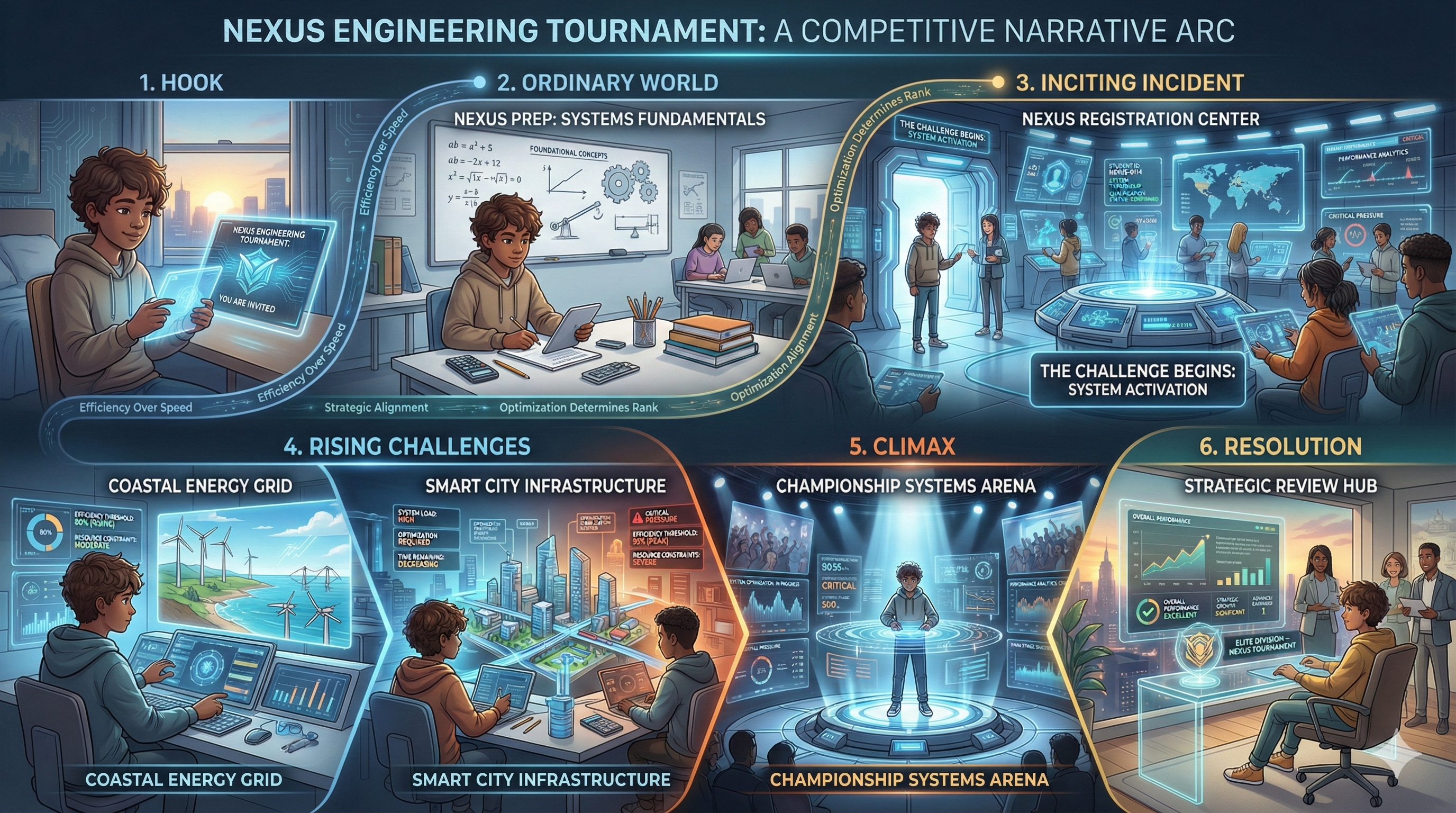
Learners enter the Nexus Engineering Tournament as Junior Systems Engineers responsible for optimizing dynamic systems under changing constraints.
Advancement depends not only on correctness, but on efficiency, adaptability, resource management, and the ability to justify why one strategy is more effective than another.
Success is determined by how effectively the learner approaches and solves a problem, not merely whether a single correct answer is reached.
Pedagogical Foundation
The design integrates complete problem-solving performances, self-regulation, higher-order thinking, and repeated experiential cycles.
Learners analyze systems, select strategies, apply decisions, manage constraints, and evaluate outcomes within complete, meaningful challenges.
Players plan, monitor feedback, evaluate performance, and adapt their strategies across repeated attempts.
Gameplay emphasizes analysis, comparison, evaluation, justification, and strategic decision-making rather than recall.
Action, feedback, reflection, and refinement create repeated opportunities to improve through experience.
Core Gameplay
Each tournament round presents a system that must be optimized under defined constraints. Players interpret data, select a strategic approach, allocate resources, observe system behavior, and refine their choices.
Immediate feedback makes cause-and-effect relationships visible, allowing learners to understand how individual decisions influence system stability and long-term outcomes.
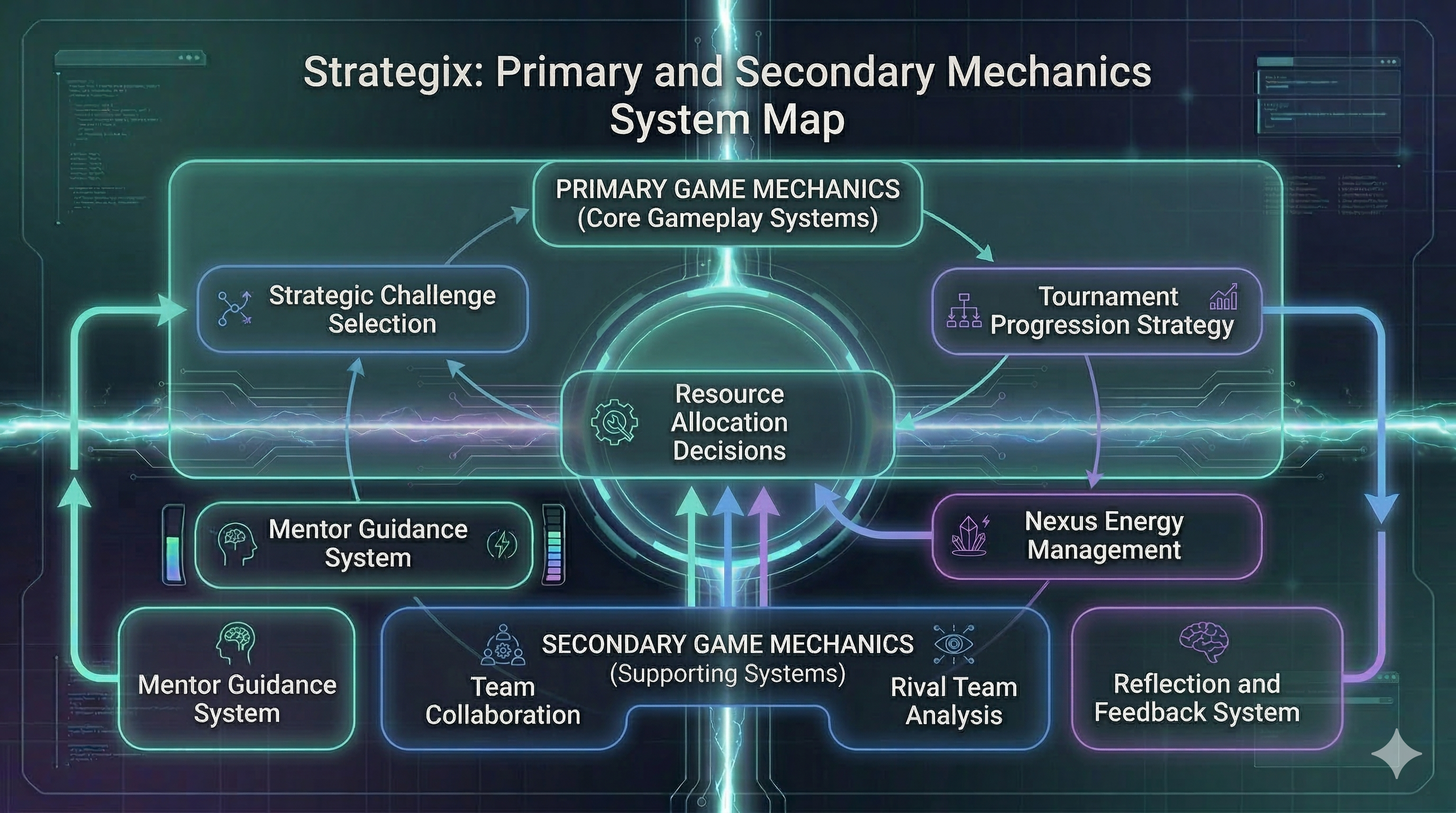
Receive a mathematics or systems-based tournament challenge.
Interpret system data, variables, constraints, and possible trade-offs.
Choose a strategy and allocate limited Nexus energy resources.
Review accuracy, efficiency, stability, and strategic effectiveness.
Compare alternatives and revise the approach during subsequent rounds.
Key Features
Each feature was selected because it supports the instructional goal rather than functioning as decoration or a separate reward system.
Advancement through tournament tiers supports persistence, visible growth, and long-term engagement.
Learners compare different approaches rather than searching for one prescribed method.
Performance reflects efficiency, decision quality, accuracy, adaptability, and system stability.
Limited resources and changing variables require prioritization, planning, and flexible thinking.
Decision logs and strategy patterns help learners and educators examine performance over time.
Increasing challenge difficulty provides scaffolding, differentiation, remediation, and enrichment.
Narrative Roles
The narrative centers on a learner protagonist, an objective evaluation framework, and a competitive benchmark for improvement.
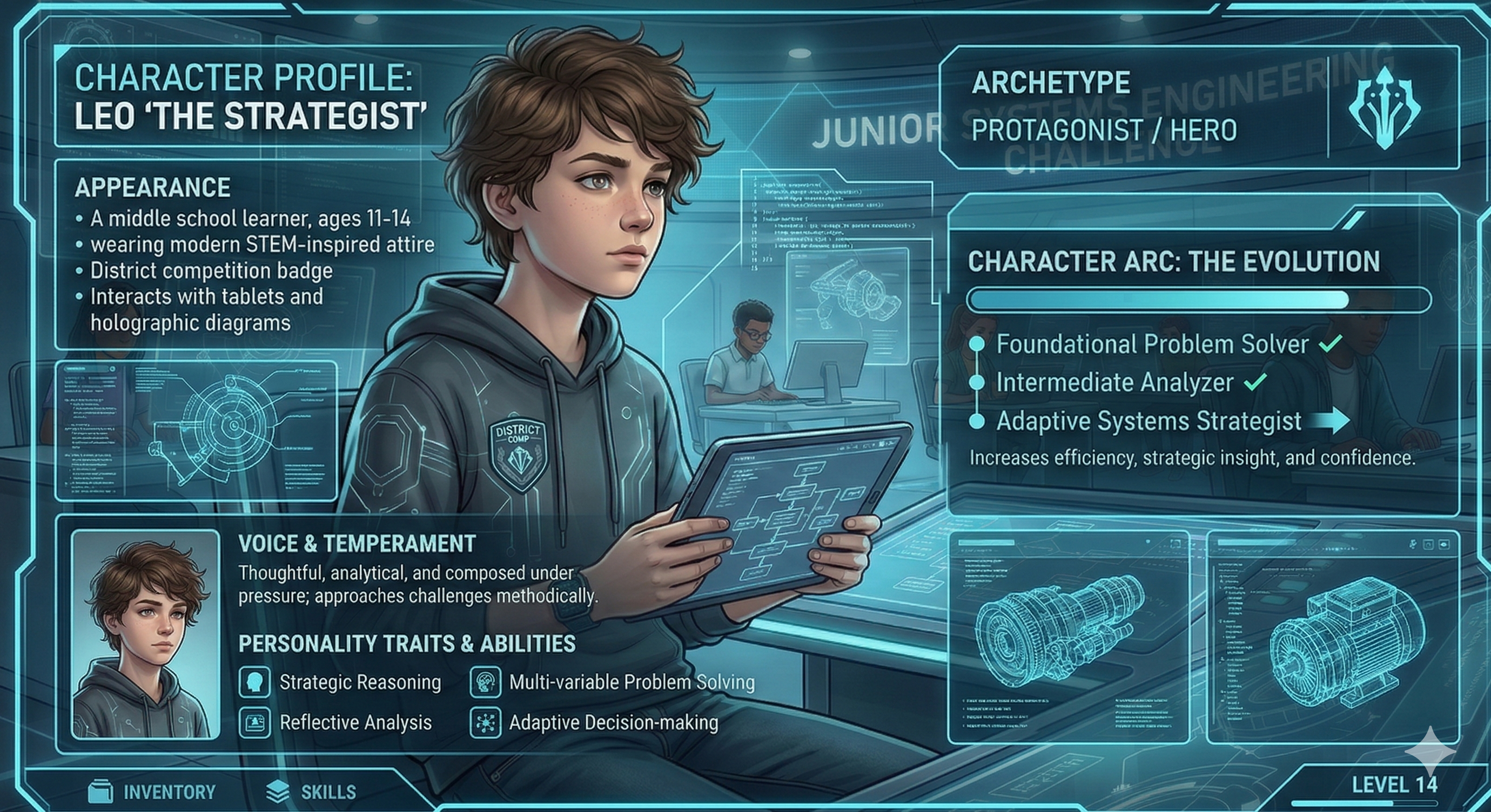
The learner evolves from a foundational problem solver into an adaptive systems strategist capable of justifying decisions under complex constraints.
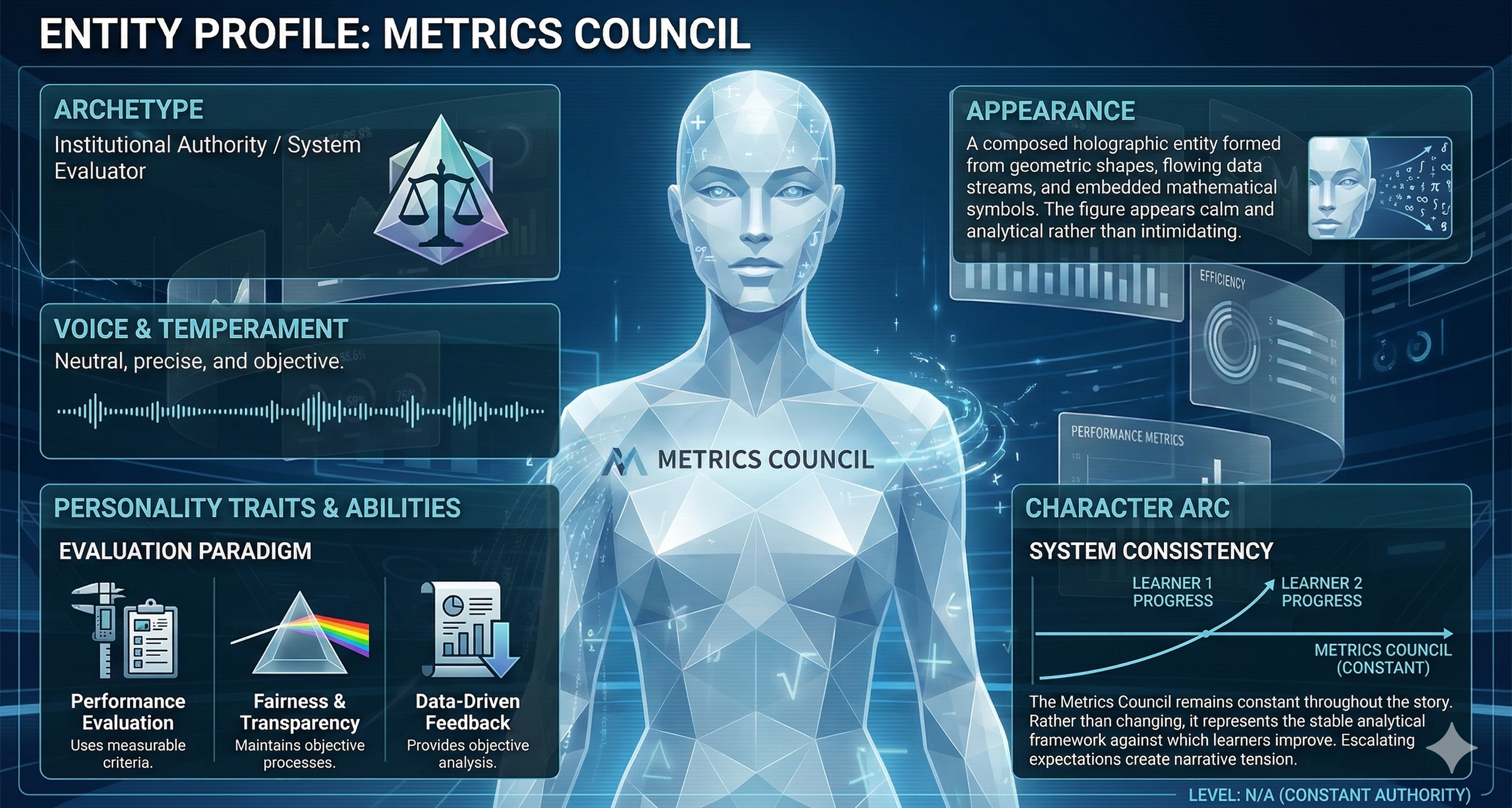
A neutral analytical authority that provides fair, criterion-referenced feedback based on efficiency, accuracy, stability, and strategic effectiveness.
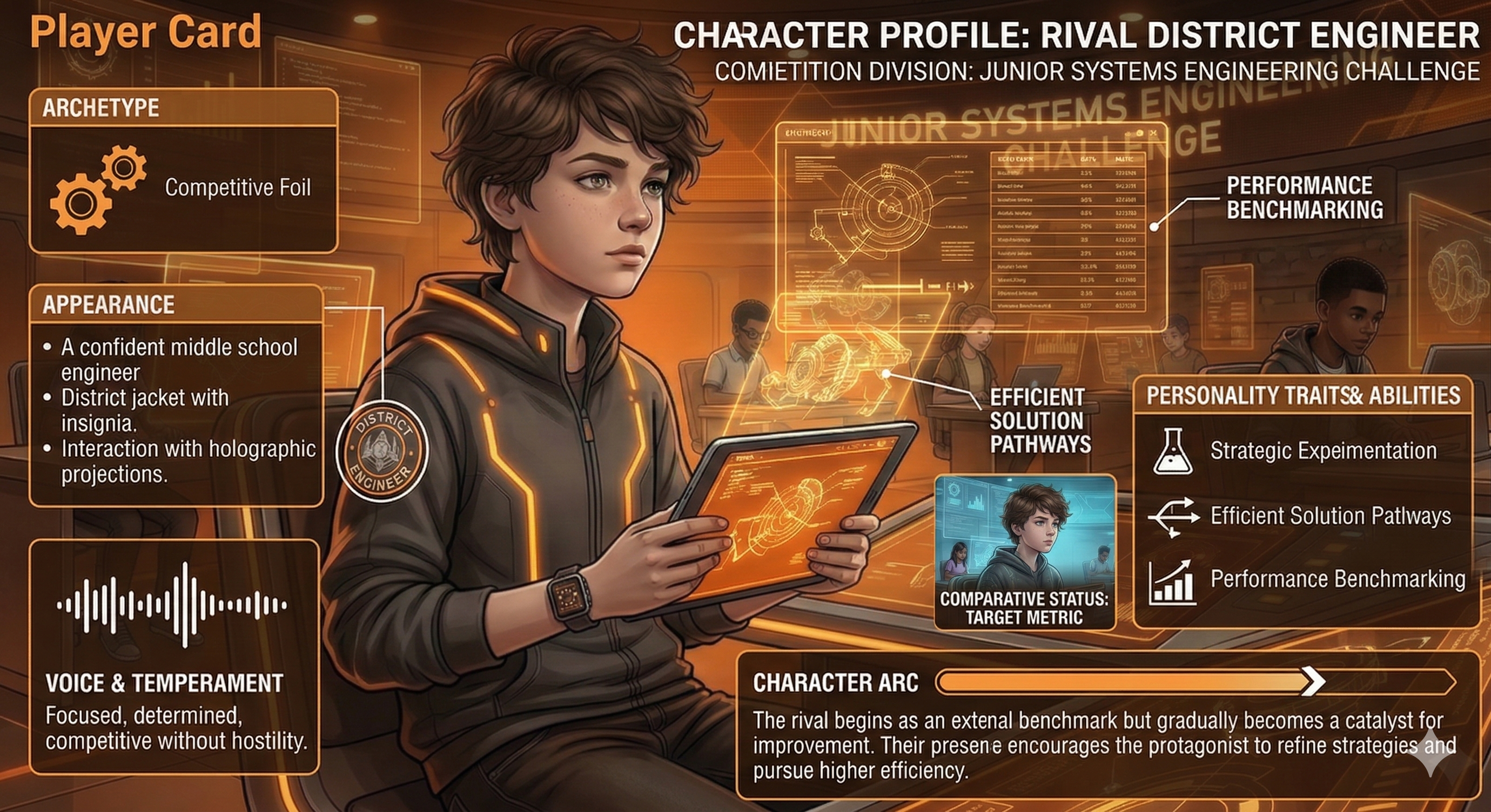
A peer benchmark who demonstrates alternative approaches and motivates learners to analyze, compare, and improve their own strategies.
Learning Environments
Each environment introduces a different instructional function, cognitive demand, and emotional tone.

A controlled environment for orientation, foundational strategy development, experimentation, and early prototype testing.

Unexpected resource reductions, higher efficiency thresholds, and multi-variable instability require adaptation under pressure.
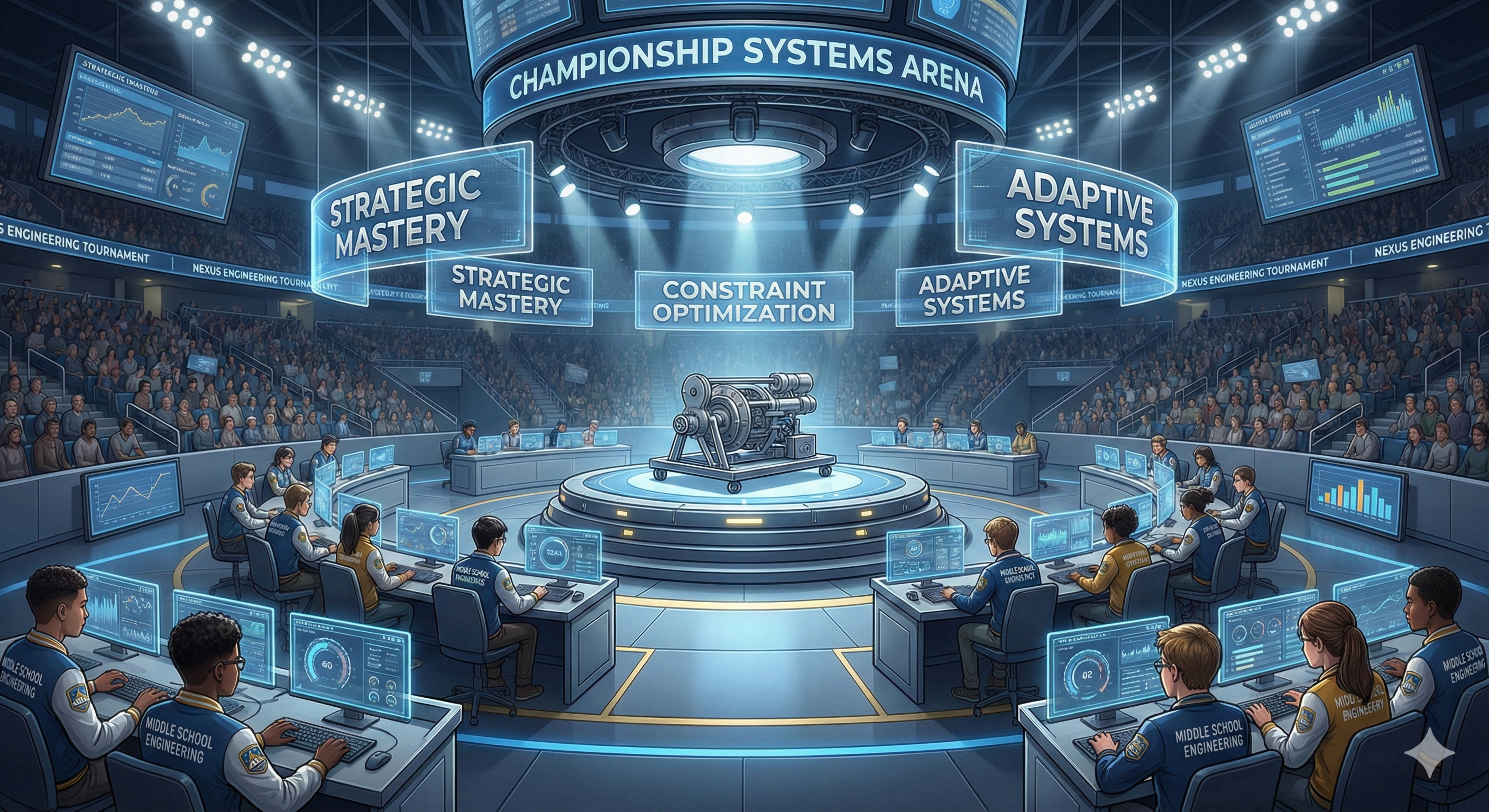
Advanced challenges demand precise decision-making, optimization, sustained performance, and strategic mastery.

Learners examine performance dashboards, compare strategies, reflect on decisions, and plan future improvements.
Assessment Through Gameplay
The game evaluates strategic performance rather than separating assessment from the learning experience.
Determines whether the mathematical or system outcome satisfies the challenge requirements.
Examines resource use, number of steps, hints, and performance relative to optimal benchmarks.
Evaluates whether the selected approach was conceptually sound, appropriate, adaptable, and well justified.
AI-Supported Design
Generative AI supported visual world-building, character exploration, environmental design, alternate concepts, and iterative refinement.
The instructional architecture, learning context, gameplay mechanics, scoring system, narrative functions, theoretical alignment, and final evaluation criteria remained human-directed.
AI accelerated concept exploration and visual production. Human evaluation determined whether each output supported the learner, gameplay, instructional goal, cognitive demand, ethical standards, and overall design coherence.
Project Deliverables
The final materials document the learning context, pedagogy, narrative, gameplay, mechanics, rules, scoring, tools, assessment, and responsible use of generative AI.
Review the complete game concept, including learning context, key features, pedagogical foundations, story elements, play mechanics, game tools, rules, goals, and AI-design narrative.
Review the concise pitch document presenting the target learners, instructional goal, market differentiators, gameplay structure, assessment approach, and design rationale.
Professional Reflection
Strategix strengthened my understanding that game-based learning is not created by adding points, badges, or competition to instructional content.
Effective instructional game design requires alignment among the learner role, narrative, mechanics, feedback, assessment, emotion, challenge progression, and instructional goal.
The strongest design decision was making strategy quality visible. Learners are rewarded for analyzing systems, selecting purposeful approaches, managing constraints, and refining their thinking over time.
Key professional insight:
The game is not separate from the instruction. The gameplay loop, scoring model, feedback system, narrative progression, and assessment evidence are all parts of the same learning system.