Avoid Neuromyths
Distinguish credible evidence from oversimplified claims about how the brain learns.
Learning Science • Cognitive Design • Evidence-Based Practice
Using cognitive science to design learning experiences that improve attention, comprehension, memory, and long-term transfer.
This case study synthesizes three connected investigations into brain basics, human perception, and learning and memory. Together, they show how biological evidence can strengthen instructional decisions without replacing cognitive psychology, learning theory, or professional judgment.
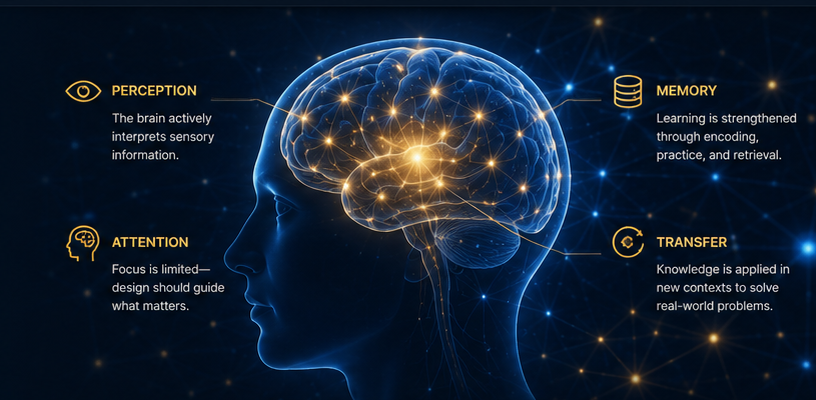
A research-and-reflection series translating neuroscience into practical instructional design principles.
The Challenge
Neuroscience can explain important biological processes, but effective instructional design requires more than adopting isolated “brain-based” strategies. The challenge was to interpret the science critically and connect it to established learning theory, learner needs, and authentic performance.
Distinguish credible evidence from oversimplified claims about how the brain learns.
Recognize what neuroscience can reveal while respecting the limits of imaging and physiological measures.
Translate biological and cognitive principles into usable instructional decisions.
Use neuroscience as one source of evidence alongside learning theory, context, and professional expertise.
Three Interconnected Research Areas
The three investigations build a coherent progression from how the brain functions, to how learners perceive instruction, to how understanding becomes durable memory and transferable performance.
Examined how neuroscience complements cognitive psychology and instructional design, how neurons and neural systems support cognition, and why scientific evidence must be interpreted with restraint.
Design question:What conditions help the brain engage in meaningful learning?
Explored perception as active construction, the influence of prior knowledge and expectations, and the role of attention in determining what learners notice and interpret.
Design question:How will different learners perceive and make meaning from the same experience?
Investigated neuroplasticity, encoding, consolidation, reconstructive memory, retrieval, reflection, and the conditions that support durable knowledge over time.
Design question:What experiences make meaningful learning more likely to endure and transfer?
Learning Process Framework
The research shifted my focus from simply presenting content to designing the conditions that help learners attend, interpret, encode, retrieve, and apply knowledge.
Each phase influences the next. Information that is not attended to cannot be meaningfully perceived. Perception is shaped by prior knowledge. Encoding and consolidation depend on meaningful organization, practice, and reflection. Retrieval strengthens access and reveals how learners reconstructed their understanding.
Instructional design should support the complete learning process rather than treating content delivery as evidence that learning occurred.
Design Implications
The value of neuroscience is not the terminology. It is the way the evidence changes how instructional experiences are structured, communicated, practiced, and evaluated.
Featured Artifacts
Each paper represents one stage in the progression from biological foundations to practical instructional implications.
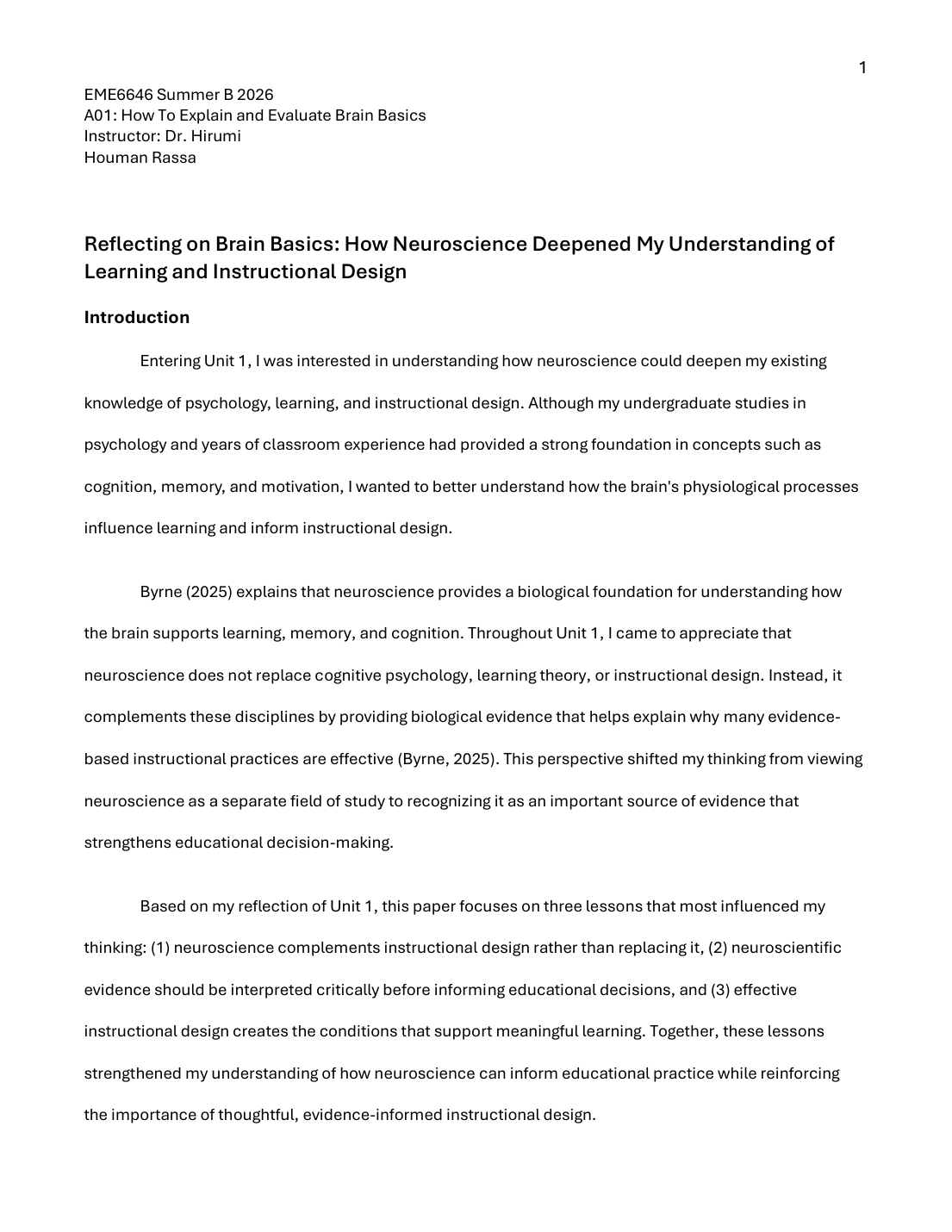
How neuroscience complements instructional design, why evidence must be interpreted carefully, and how designers create conditions that support learning.
Open Paper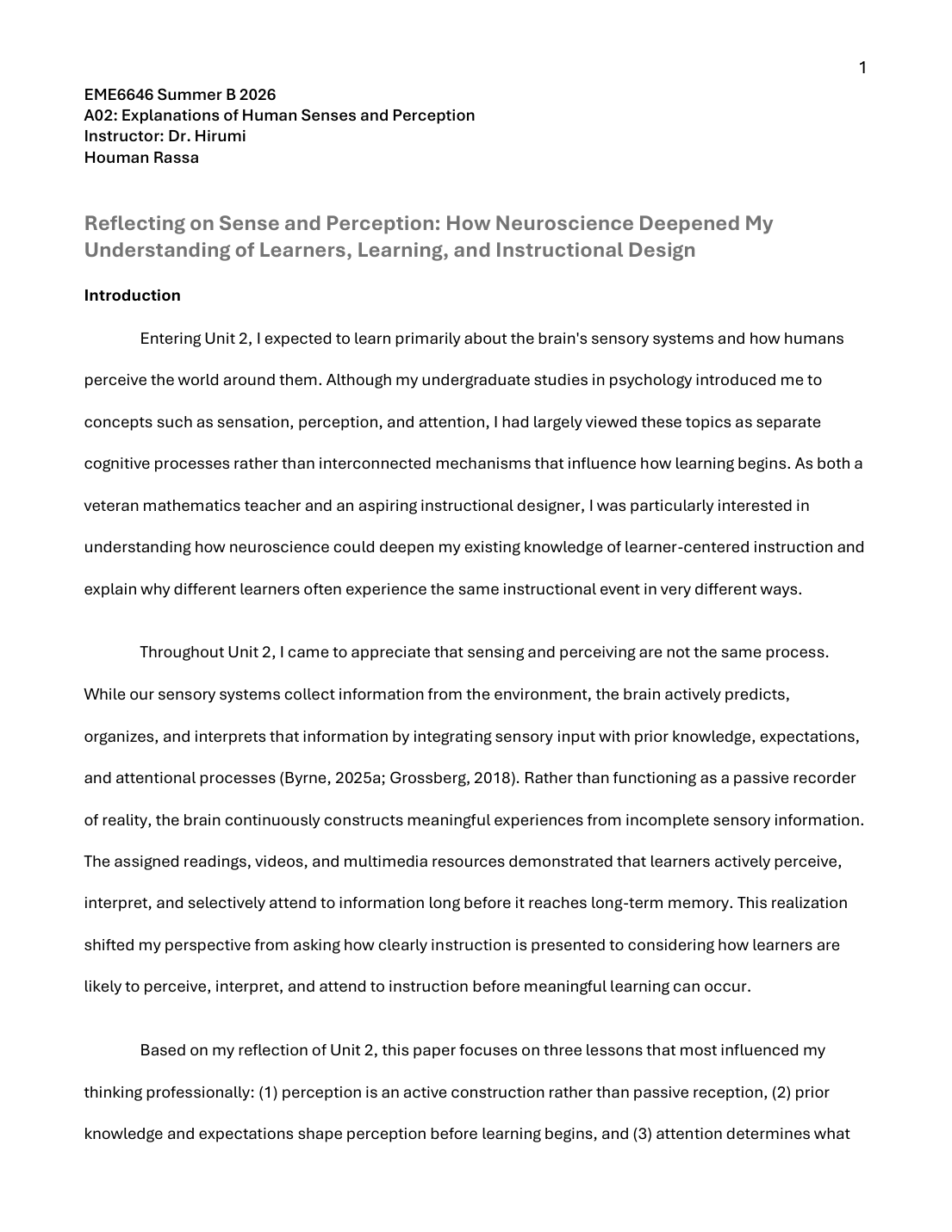
How active perception, prior knowledge, expectations, and selective attention shape the learner’s experience before memory begins.
Open Paper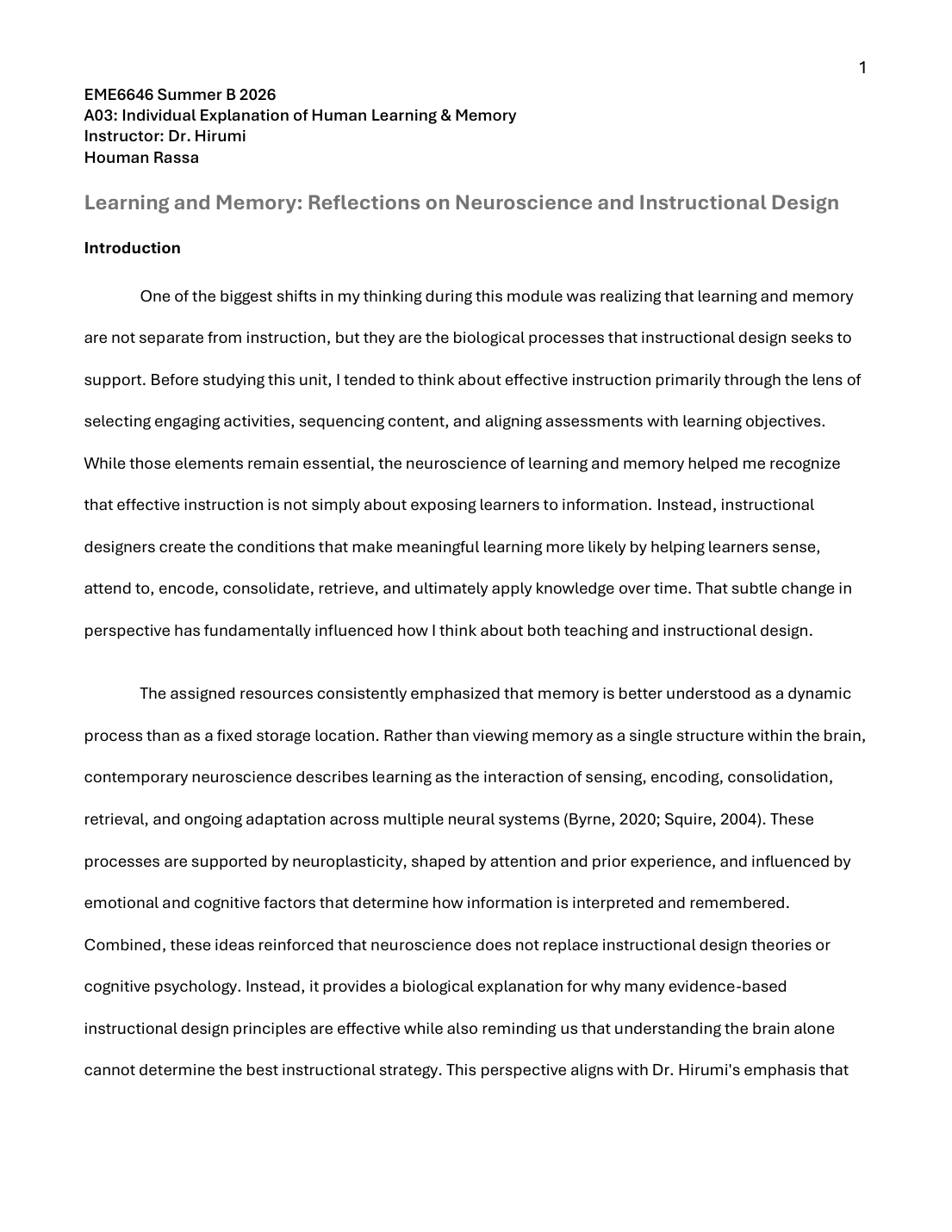
How neuroplasticity, encoding, consolidation, reconstructive memory, retrieval, and reflection influence durable learning.
Open PaperMy Reflection
Studying neuroscience fundamentally changed the questions I ask while designing instruction.
I no longer treat exposure, engagement, or immediate correctness as sufficient evidence of meaningful learning. I now consider how learners are likely to direct attention, interpret information through prior experience, organize knowledge, reconstruct understanding during retrieval, and apply learning beyond the original context.
Neuroscience did not replace the instructional design principles I already valued. It gave me a deeper explanation for why many of those principles work and reinforced the need to combine scientific evidence with learner analysis, context, evaluation, and human judgment.
Capabilities Demonstrated