Alignment
Connect every item and task to specific standards, objectives, and intended cognitive demand.
Assessment Design · Curriculum Alignment
Designing valid evidence of what learners understand and can do.
A comprehensive criterion-referenced Algebra 1 assessment system that aligns standards, instructional objectives, cognitive demand, objective items, an authentic performance task, an analytic rubric, and equitable learner supports.
The project transformed a linear relationships and equations unit into a complete assessment architecture built to measure conceptual understanding, mathematical reasoning, communication, and transfer.
The Design Challenge
The assessment needed to produce trustworthy evidence across multiple forms of mathematical performance while remaining accessible to learners with different language and learning needs.
Connect every item and task to specific standards, objectives, and intended cognitive demand.
Measure whether learners can apply linear relationships to a realistic decision rather than recall procedures in isolation.
Build a balanced evidence plan that supports defensible interpretations of learner mastery.
Reduce construct-irrelevant barriers for LEP and SLD learners without lowering the mathematical expectations.
Design Foundation
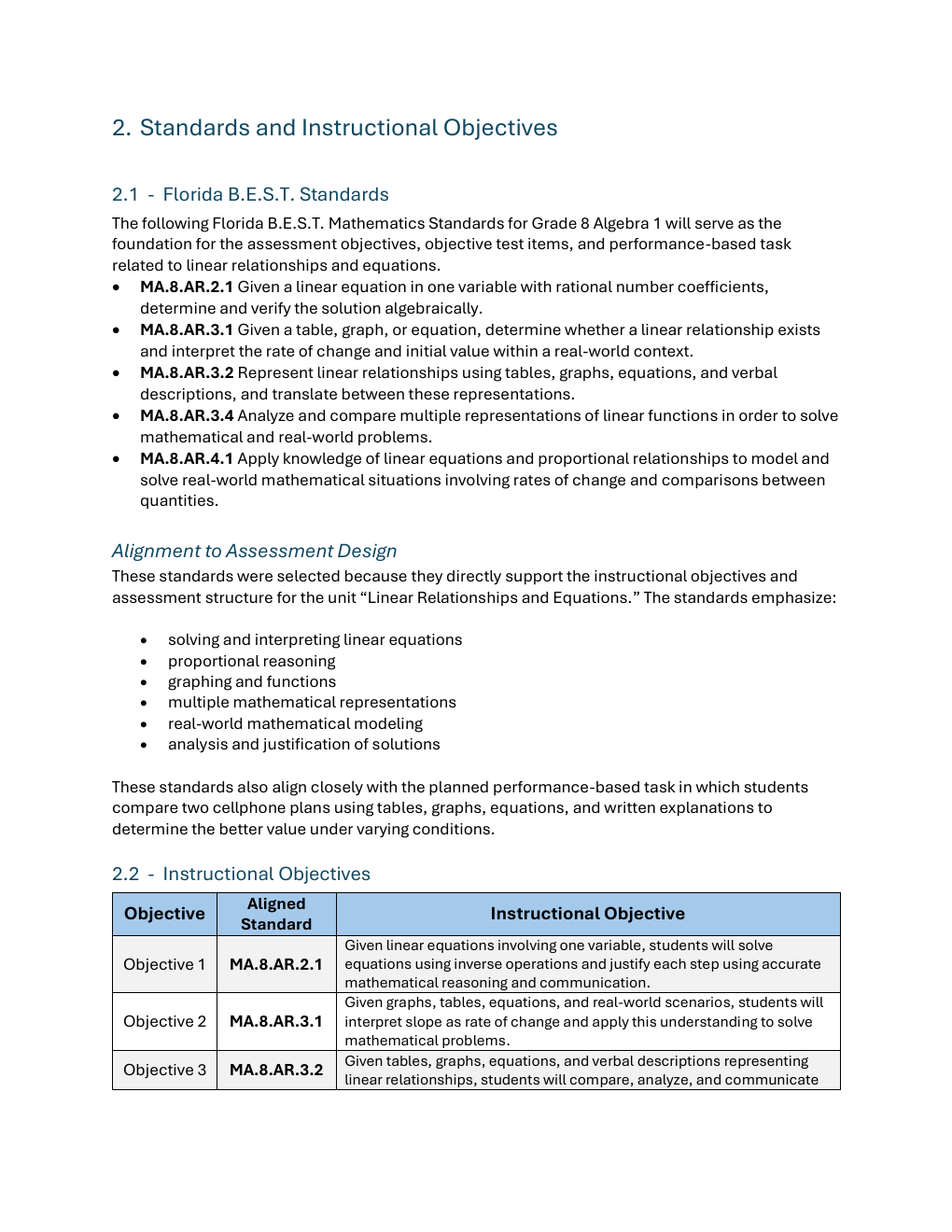
The project began by translating five Florida B.E.S.T. standards into measurable instructional objectives. Each objective described the conditions, expected learner performance, and evidence required to demonstrate mastery.
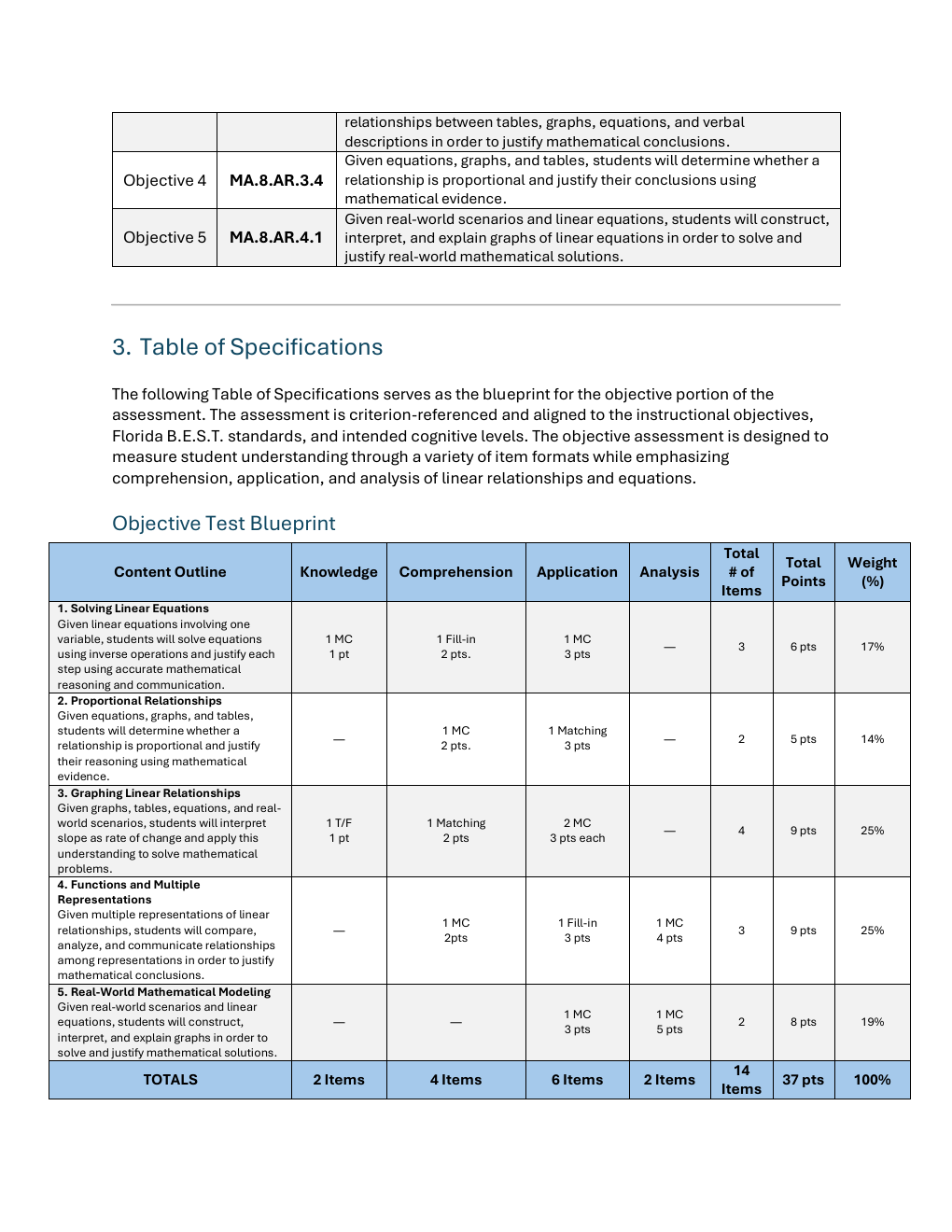
Rather than writing questions first, I developed a Table of Specifications that distributed content, cognitive levels, item formats, points, and weighting across the unit. This blueprint became the control document for the entire assessment.
Assessment construction would begin with the evidence needed to support instructional decisions, not with a collection of convenient test questions.
My Process
The process maintained traceable alignment from the intended learning to the final scoring decisions.
Define learners, instructional setting, assessment purpose, and decision needs.
Translate standards into observable, measurable instructional objectives.
Use a Table of Specifications to balance content and cognitive demand.
Create varied objective items with answer keys and item rationales.
Build an authentic cellphone-plan comparison requiring multiple representations.
Create an analytic rubric and accommodations that preserve construct validity.
Evaluate alignment, clarity, difficulty, fairness, and evidence quality.
Assessment Architecture
The objective assessment used multiple-choice, matching, true/false, and fill-in items across knowledge, comprehension, application, and analysis. Weighting emphasized application and analysis rather than recall.
Authentic Performance
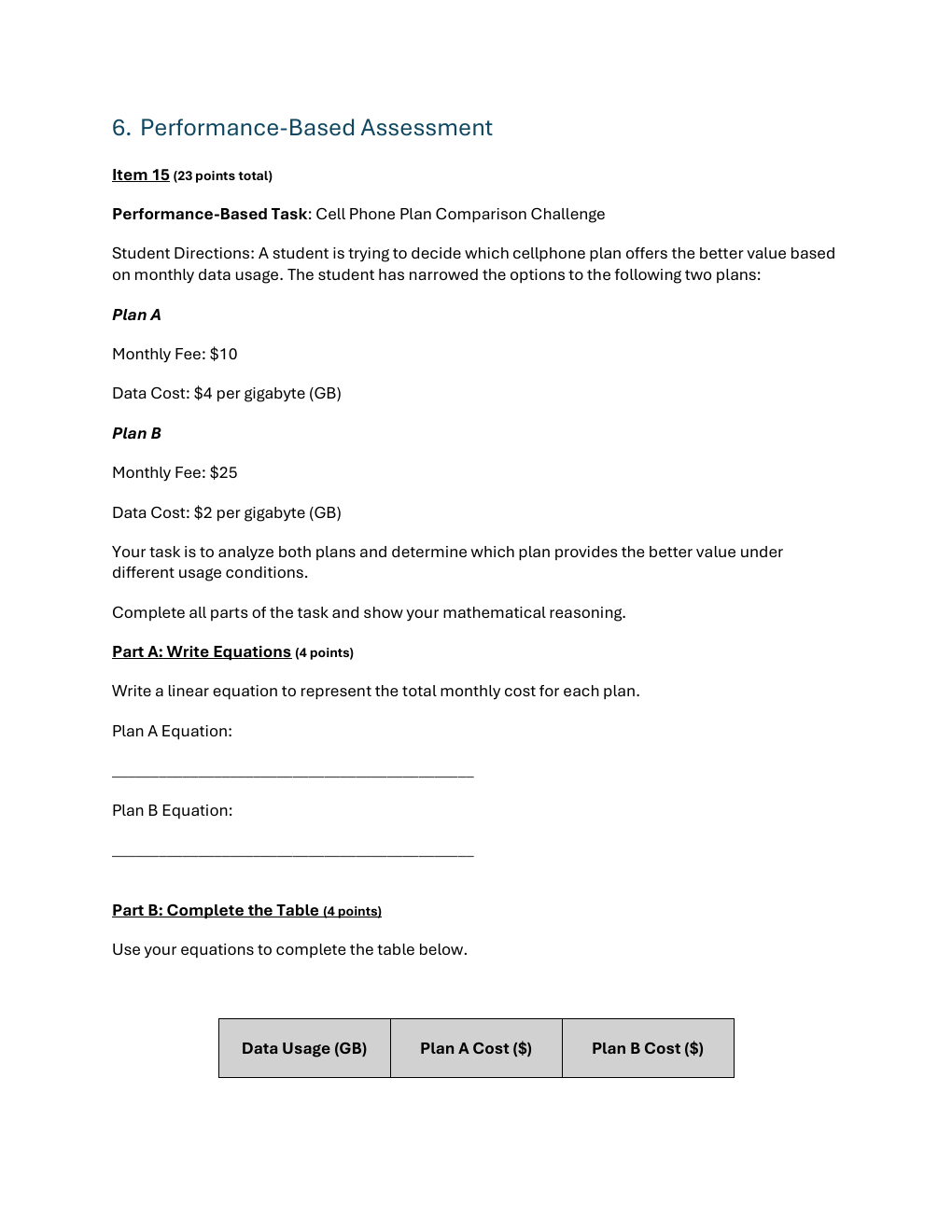
The performance task asked learners to compare two cellphone plans using tables, graphs, equations, intersection analysis, and written justification. The task measured whether learners could coordinate multiple representations and defend a recommendation under changing conditions.
An analytic rubric separated mathematical accuracy, representation, reasoning, interpretation, and communication so feedback and scoring could reveal where performance was strong or incomplete.
A correct answer alone could not demonstrate mastery. Learners had to show how their representations connected and why their recommendation was mathematically justified.
Accessibility and Fairness
Supports were selected to improve access to the assessment construct without changing the intended mathematical knowledge and reasoning.
The supports help learners demonstrate the same intended knowledge and performance through fewer construct-irrelevant obstacles.
Design Artifacts
Selected pages reveal the alignment, blueprinting, authentic task design, scoring, and accessibility decisions behind the final assessment.
Traceable alignment between Florida B.E.S.T. standards and measurable outcomes.
Distribution of content, cognitive demand, item types, points, and weighting.
A real-world cellphone-plan comparison requiring coordinated representations.
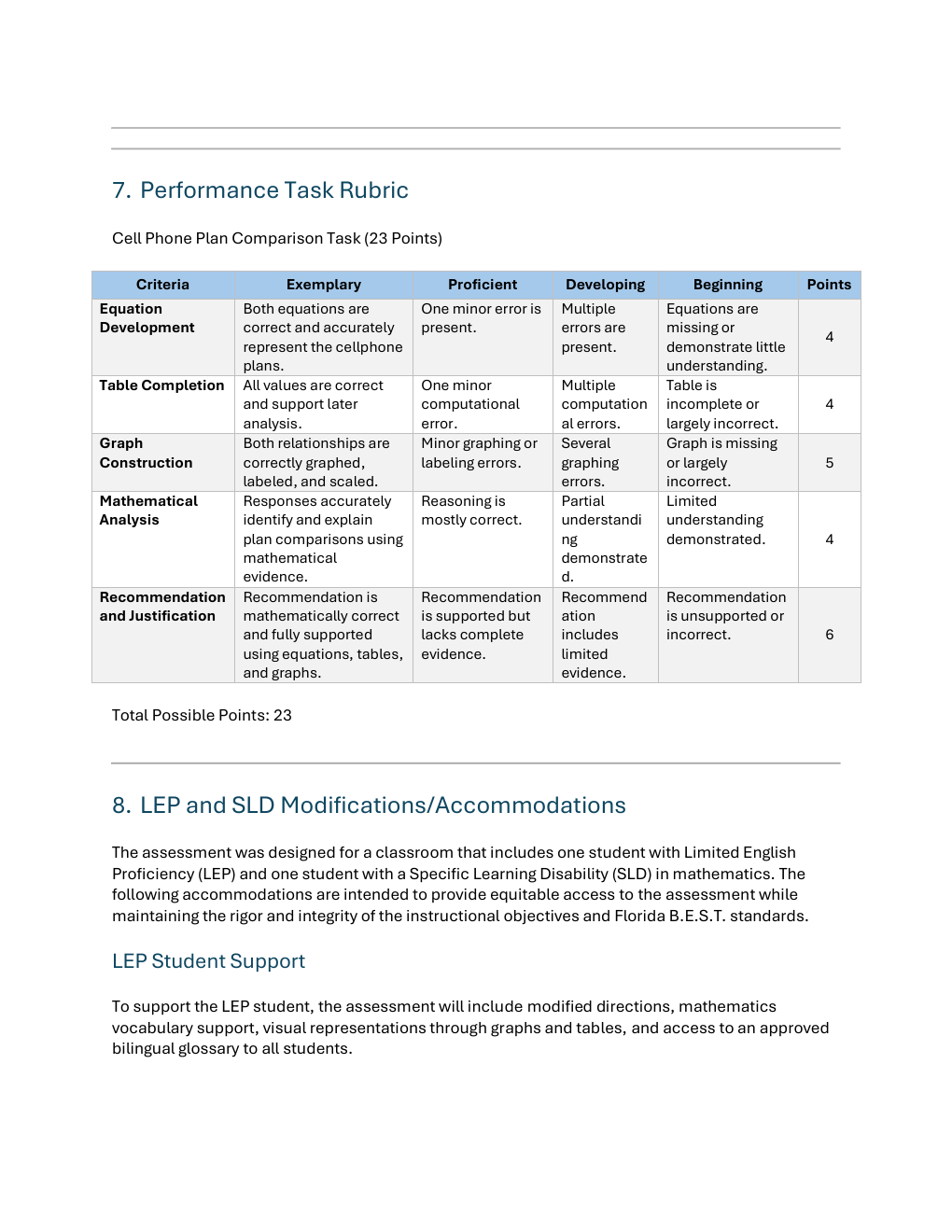
Analytic scoring and accommodations designed to maintain rigor and fairness.
Reflection
This project changed how I think about evidence of learning. A strong assessment is not a collection of questions. It is a coordinated system connecting intended outcomes, learner performance, scoring decisions, accessibility, and instructional action.
The greatest value of the process was learning to work backward from the evidence needed to support a meaningful conclusion. That mindset now influences how I design objectives, activities, feedback, and evaluation across instructional settings.
Capabilities Demonstrated